Here you can find names, dates of life, biographies and family stories about Jewish life in Lüneburg. Do you have further information, corrections, photographs, documents or suggestions?
Please feel free to contact us so that we can update the pages.
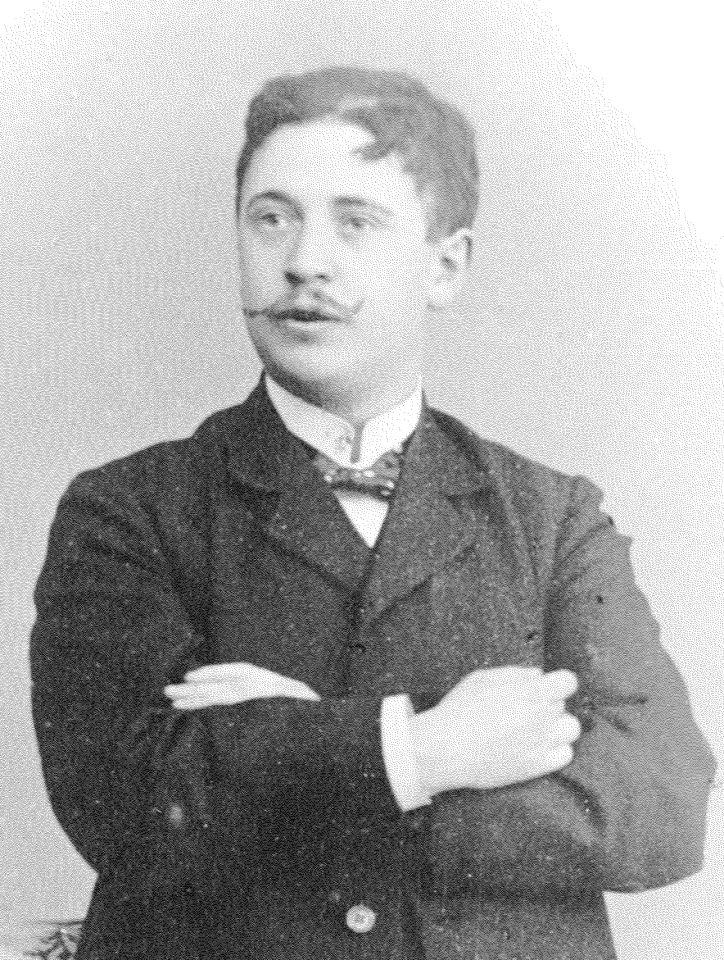
Wilhelm (Meshulam) Heinemann, always called Willy, was the sixteenth, penultimate child of the Lüneburg banker and merchant Marcus Heinemann and his wife Henriette, née Lindenberg. He was born in Lüneburg in 1880 and grew up among his many siblings at Große Bäckerstraße 23. At the time of his birth, his eldest sisters Betty and Emma were already married themselves and had children. Together with his brother Otto, born in 1876, and his sister Else, born in 1879, Willy was one of the “little ones” in the family.
When Willy was three years old, his mother Henriette died of a serious infection, shortly after the birth of his youngest brother Henry. Henriette"s sudden death brought deep sadness and despair to the family. From then on, Willy"s 21-year-old sister Martha looked after him and the other younger siblings like a mother. Her sister Emilie later recalled how well Martha fulfilled this role: “The little children asked: ”Marthe, why don"t we say Mama like the other children do?” So they didn"t feel that their mother was missing.”
Like all his brothers, Willy attended the traditional Johanneum grammar school in Lüneburg. He started at the age of 9, but did not last long: He left school at the age of 11 and was taught at home from then on. From various family accounts, it is clear that Willy had problems concentrating and was also physically very weak. His sister and confidante Emilie later wrote: “Willy was ill a lot as a child. The doctor said that his organs were not fully developed because the children followed each other too quickly.”
While most of his siblings left home in the 1880s and 1890s, married and started families, Willy and his older sisters Emilie and Martha stayed at home with their father Marcus Heinemann. Willy seems to have lovingly cared for his father, especially in old age: “Willy always took touching care of Papa,” Emilie wrote in her memoirs, “and faithfully accompanied him to the Schleuse [a restaurant near Lüneburg]. Sometimes he felt that it was harder to guide Papa on the way back. But he was happy to be able to support him.”
Willy started taking private photographs at an early age - at a time when this was still something very special. We have him to thank for many beautiful pictures of the Heinemann family, mostly taken outside in the idyllic garden behind the main house in Große Bäckerstraße. Later, Willy also worked as a professional photographer.
After Marcus Heinemann died in 1908 at the age of almost 90, Willy, Emilie and Martha remained in their family home. Their father had generously provided for them all in his will. With regards to Willy, Marcus Heinemann included an important restriction: "In the interests of my son, who could easily be tempted by the kindness of his heart to lend or give away his fortune, I stipulate that he shall have no disposal over the capital, but shall only receive the interest for the rest of his life. [...] He is entitled to freely dispose of everything that my son Willi receives from the inheritance apart from the capital [...] and everything else that he will already possess at my death, as well as the interest on the capital. He is also free to dispose of everything that he acquires through his work or that comes to him as a gift or inheritance. All the furniture in the parlor and adjoining bedchamber in which he lives shall be his free property. Furthermore, the bookcase in my living room, which is near the stove.”
From 1908 to 1922, Willy Heinemann was listed in the Lüneburg address book as a photographer. He took photos for a publishing house with Lüneburg postcards, for private clients and various clubs and associations. To quote Emilie once again: “He suffered from the fact that he could not achieve more, but he enjoyed his work. His photographs showed a lot of understanding for the artistic eye.” His two sisters supported him in his work, as Emilie recalled: “Willy always knew how to bring something stimulating with him, his business, albeit insignificant, brought life into the house. Martha and I helped him as much as we could. Martha did the calculations and taught him bookkeeping. Willy had only been at school for a short time. His doctor made us arrange for tutors. He had good teachers.”
In his empathetic manner, Willy apparently became known in Lüneburg for a special form of photography that still played an important role at the beginning of the 20th century: “He was also the only one who could take pictures of the dead. Some families asked him for a picture of their beloved dead child and were grateful to him.”
It was this activity that led to Willy"s early death, as Emilie described: “He came home late on his last outing. He had fulfilled a mother"s wish, the child had died of head cold. The doctor said he hadn"t caught it. Our dear Willy was no longer so fresh: head cold or sleeping sickness [a rare form of encephalitis] brought him to his grave after several weeks. All three of us had settled in well together.”
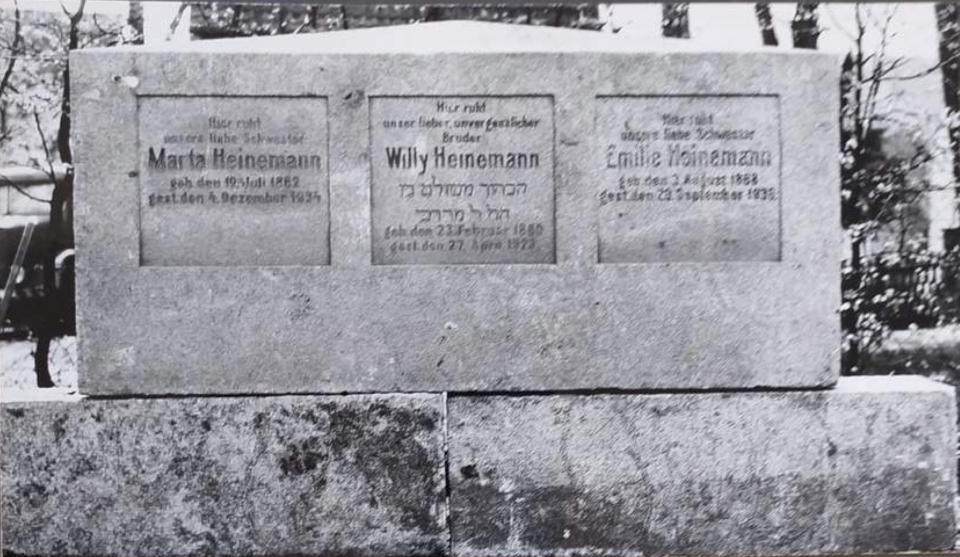
Willy Heinemann died in April 1923, deeply mourned by his family, and was buried in the Jewish cemetery in Lüneburg. On his gravestone, it says in Hebrew: "the bachelor Meshulam, son of the Thora-educated Mordechai". Emilie noted his death in the Heinemanns" family Bible, calling Willy “our faithful comrade”. Presumably Emilie and Martha had already decided that the three siblings should be buried together. In any case, the two sisters were later buried next to Willy, Martha in 1934 and Emilie in 1936.
The gravestone for the three Heinemann siblings is one of the few stones that still exist today - after the cemetery was destroyed and completely leveled during the Nazi era. Together with several other gravestones, it had temporarily been used as building material in the foundations of a makeshift home erected in 1944. When this makeshift home was demolished in 1967, the stones came to light. It was several years before the gravestones were re-erected in the early 1970s, albeit not at their original place, and only as fragments. The stone for the Heinemann siblings is one of them.
Sources and info:
Gravestone for Mart(h)a, Willy and Emilie Heinemann: epidat - Forschungsplattform jüdische Grabsteinepigraphik, Lüneburg, lbg-13
Emilie Heinemann"s memoirs, Stadtarchiv Lüneburg, NBi 33
Name variants: Wilhelm Willi Meschullam Meshulam