Here you can find names, dates of life, biographies and family stories about Jewish life in Lüneburg. Do you have further information, corrections, photographs, documents or suggestions?
Please feel free to contact us so that we can update the pages.
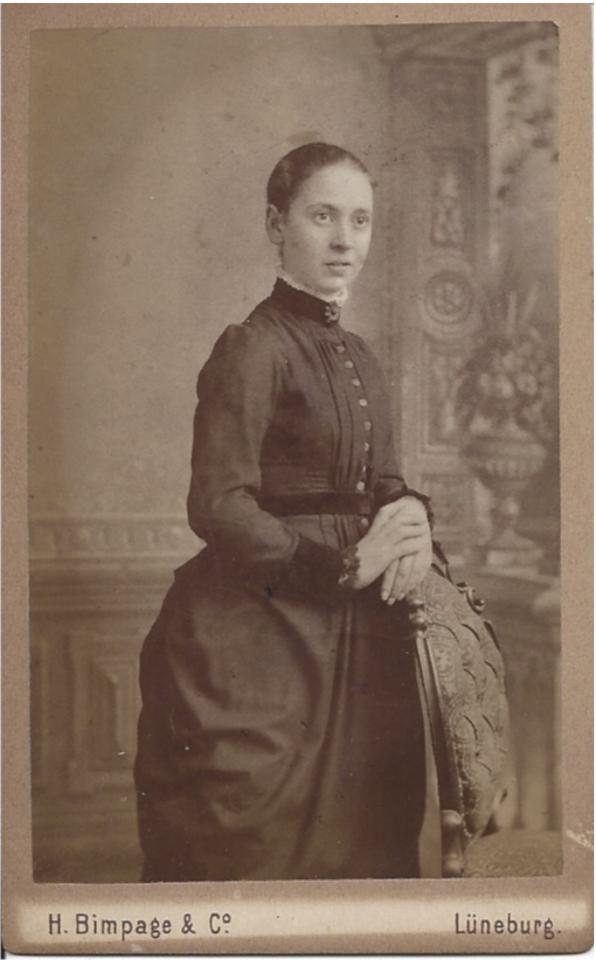
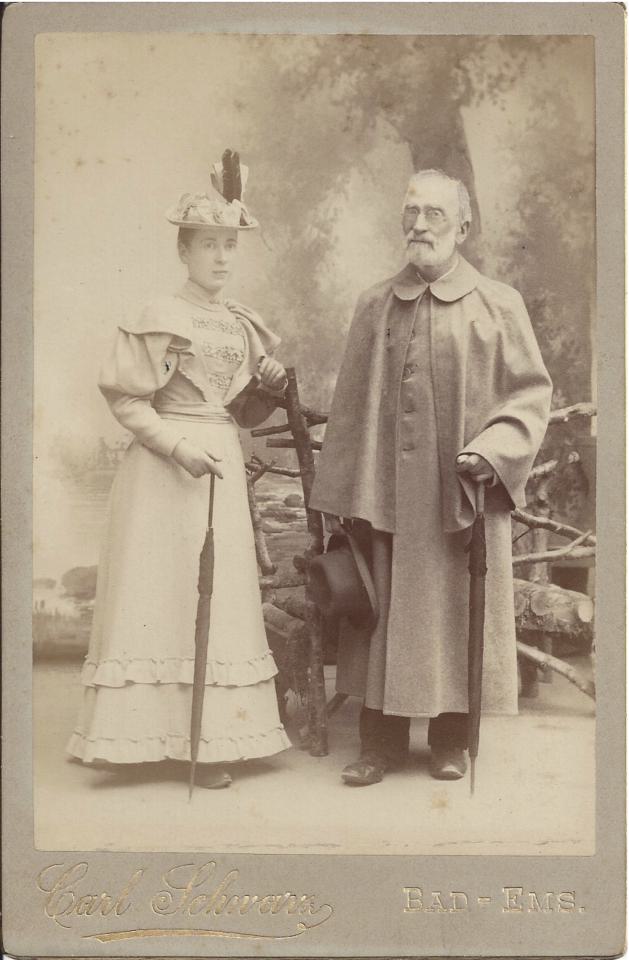
Emilie Heinemann was the tenth of 17 children of Lüneburg merchant and banker Marcus Heinemann and his wife Henriette, née Lindenberg. She was called “Mietze” in the family. When Emilie was born in 1868, the family already lived in the large patrician house at Bäckerstraße 23, where Emilie grew up surrounded by her many siblings.
Her sister Klara, who was four years older, recalled a carefree childhood in Lüneburg"s old town, including early learning in a kind of pre-school and playing with the neighborhood children. Looking back, Emilie herself described everyday family life in the Heinemann house as follows: “Our mother was always busy, she probably complained of headaches from time to time, but we children didn"t feel that our large number caused her any discomfort. One child had to help the other, there wasn"t much help, and laundry and clothes had to be sewn all the time. [...] Our father often had to ride overland on business, which worried Mom a lot because he often came back late. Later we went by wagon - during the vacations we were allowed to go with him and got to know the Lüneburg heath in all its solitude. The landowners entertained us with coffee and cake, and Dad was happy with his children.”
The family took their Judaism rather seriously. At the same time, they were open to the world, as Emilie"s memories show: “Papa was very religious. He went to synagogue on Friday evenings and Saturdays. Friday evening was always a real holiday: a festive meal, lights on the table, a happy atmosphere. All business was suspended and the little ones were allowed to stay up late. On Saturday afternoons, Dad played chess in the Schleuse [a restaurant near Lüneburg], and he was happy to take his children and grandchildren with him.”
Emilie was 15 years old when her mother died unexpectedly of an infection, shortly after the birth of her youngest child in 1883. Emilie"s two eldest sisters Betty and Emma were already married and had started families of their own in Lüneburg. Her 21-year-old sister Martha took over the household, became a mother substitute for the younger children and increasingly their father"s main support. But Emilie, together with her slightly older sisters Klara and Auguste, also had to bear great responsibility in the family from then on.
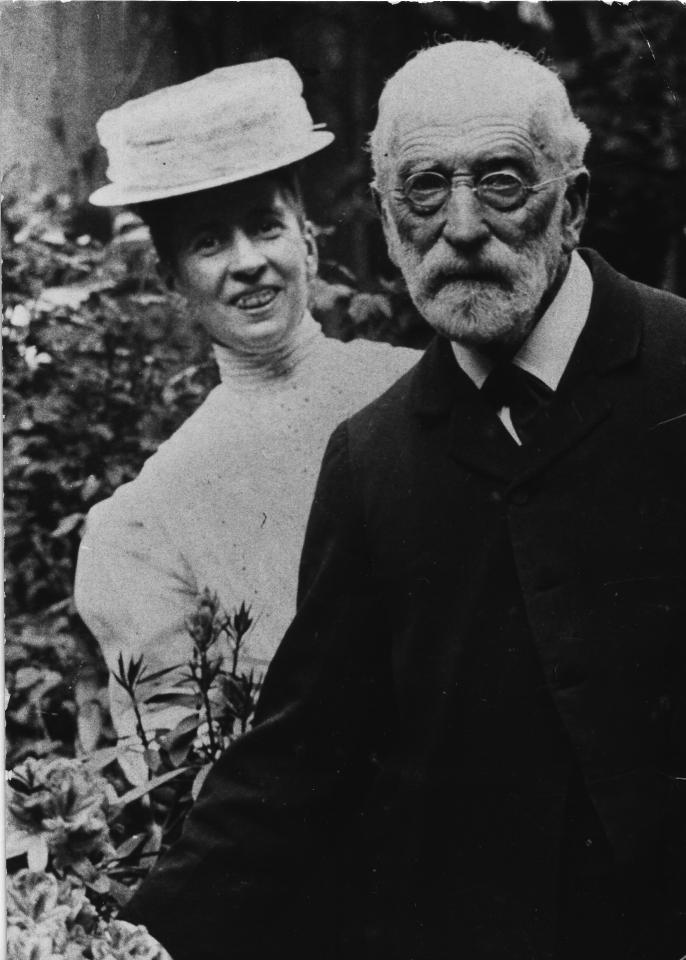
In the 1880s and 1890s, almost all the siblings gradually left the house. Emilie, Martha and their younger brother Willy, who needed care, stayed behind with their father. Around the turn of the century, Martha became chronically ill. The burden of everyday life and organizing the household now fell mainly on Emilie. Her father, who was approaching ninety, also increasingly needed her help.
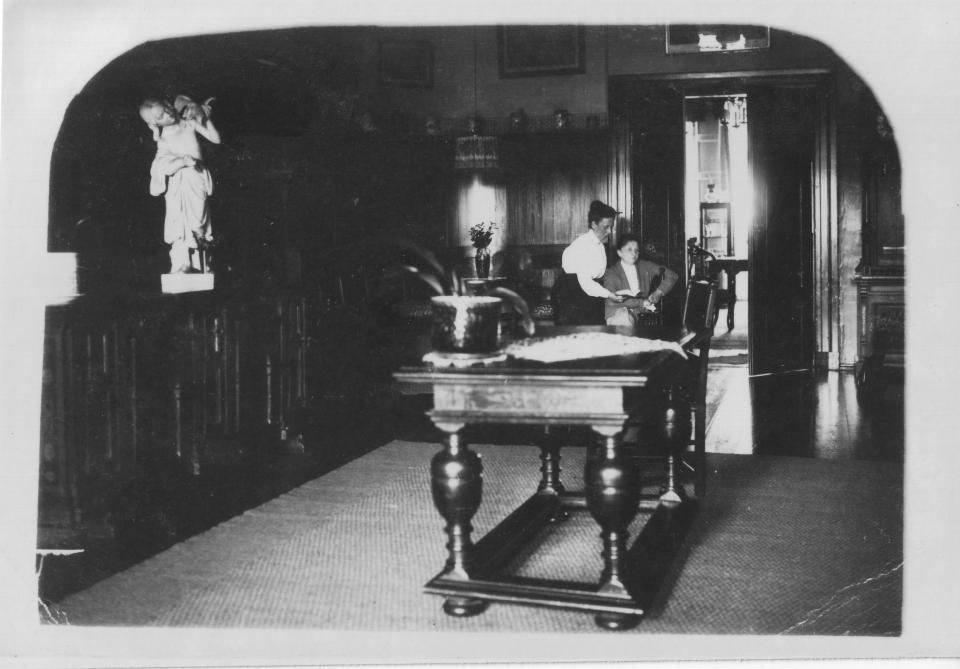
After their father"s death at the end of 1908, the three siblings stayed in the house which now belonged to their youngest brother Henry, who was living in Sumatra. Emilie and Martha had the old building renovated and rebuilt, and large parts of the house were rented out. During the First World War, they were supported by all their siblings and thus got through the difficult times.
In the 1920s, however, their financial situation deteriorated. Inflation caused their inheritance to dwindle. They also had to pay high medical bills for Martha. Willy, who had at least earned a small income as a photographer, died in 1923. Emilie and Martha carried on alone, presumably with financial help from their older siblings.
In October 1934, their eldest sister Betty Jacobsohn died in Lüneburg. And in December 1934, Martha, with whom Emilie had shared her life since birth, died. Emilie"s notes from early 1935 show that Martha, facing Nazi rule since 1933, had lost all her will to live. Emilie wrote: “Martha could not overcome the hard times of the Jews.”
The Heinemann siblings, nieces and nephews gathered in Lüneburg for Martha"s funeral in the Jewish cemetery. Many of them were already preparing to emigrate from Germany. Sister Anna Levy traveled from Berlin. She wrote to her son Ernst Levy in Paris: “There were wistful hours of remembrance in the parental home. Ida and Else from Hanover were there, Ernst and Walter from Hamburg. I stayed with the Jacobsons, Henry and Gerda as always touchingly attentive, the children delightful, Aunt Clärchen was unfortunately ill, but was especially happy with me. The circle in Lüneburg is getting smaller and smaller, life goes its way, one generation replaces the other.”
Emilie witnessed how more and more family members left the country to escape the escalating Nazi persecution of Jews. She noted: “Summer 1935. Unfortunately, the situation of the Jews in Germany is very difficult. Trade and change are made more difficult. The families who love and respect Germany as their homeland have to go far away so that their children can learn something. Aren"t the Jews human beings too? Don"t we all believe in one God? I only wish one thing: may all these sad fates not embitter the hearts of the Jews, may the good Lord keep our hearts pure and give us the courage to enjoy God"s word and God"s beautiful nature. The sad thing is that today"s world wants to teach children that all Jews are bad people and inferior, that contact with them is harmful. But I hope that this view will change again. [...] Poor Jews.”
In May 1936, Emilie"s niece Lotte Heinemann also fled Nazi Germany to start again in the USA. She had tried until the end to keep her head above water as a doctor in Lüneburg, although she had been harassed throughout because of her Jewish origins. Around the same time, Emilie"s sister Klara "Clärchen" Jacobson"s family also gave up their residence in Lüneburg and moved to Hamburg.
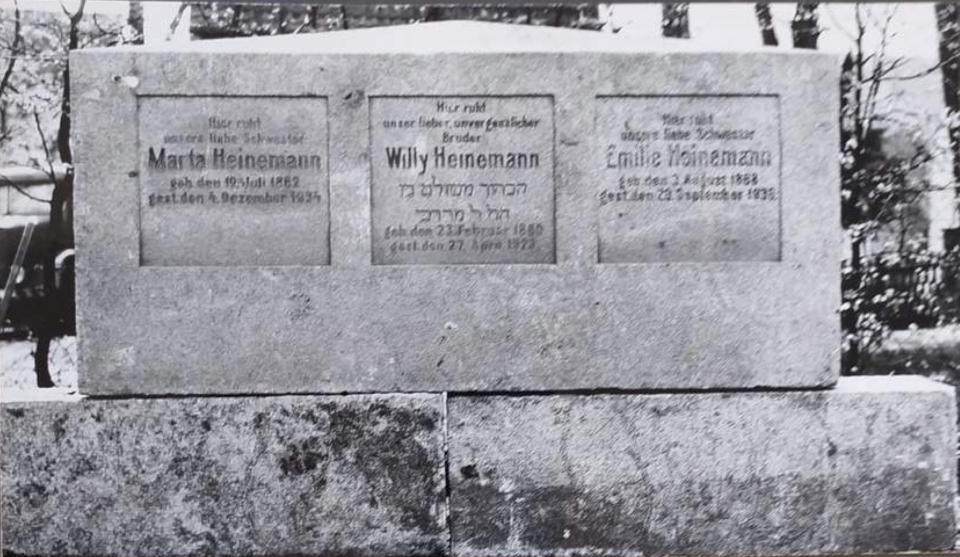
In August 1936, Emilie fell seriously ill and had to be taken to the Israelite Hospital in Hamburg. Her niece Gertrud Heinemann worked there as a nurse. It was in this hospital that Emilie Heinemann died in September 1936, at the age of 68. She was the last member of the large Lüneburg Heinemann family to be buried in the town"s Jewish cemetery - alongside her siblings Willy and Martha.
The gravestone for the three siblings is one of the few that remained after the cemetery was destroyed and completely leveled during the Nazi era. Together with several other gravestones, it had been built into the foundations of a makeshift home which was erected in 1944. When this makeshift home was demolished in 1967, the stones came to light. It took a few more years before the gravestones were re-erected as fragments in the early 1970s.
Sources and information (in German):
Gravestone for Mart(h)a, Willy and Emilie Heinemann: epidat - Forschungsplattform jüdische Grabsteinepigraphik, Lüneburg, lbg-13
Klara Jacobson"s letter to her daughter with memoirs; Stadtarchiv Lüneburg, NMa117
Memoirs of Emilie Heinemann; Stadtarchiv Lüneburg, NBi33
Anna Levy"s letter to her son Ernst, mid-December 1934; Private collection René Lévy
Name variants: Mietze, Mieze