Here you can find names, dates of life, biographies and family stories about Jewish life in Lüneburg. Do you have further information, corrections, photographs, documents or suggestions?
Please feel free to contact us so that we can update the pages.
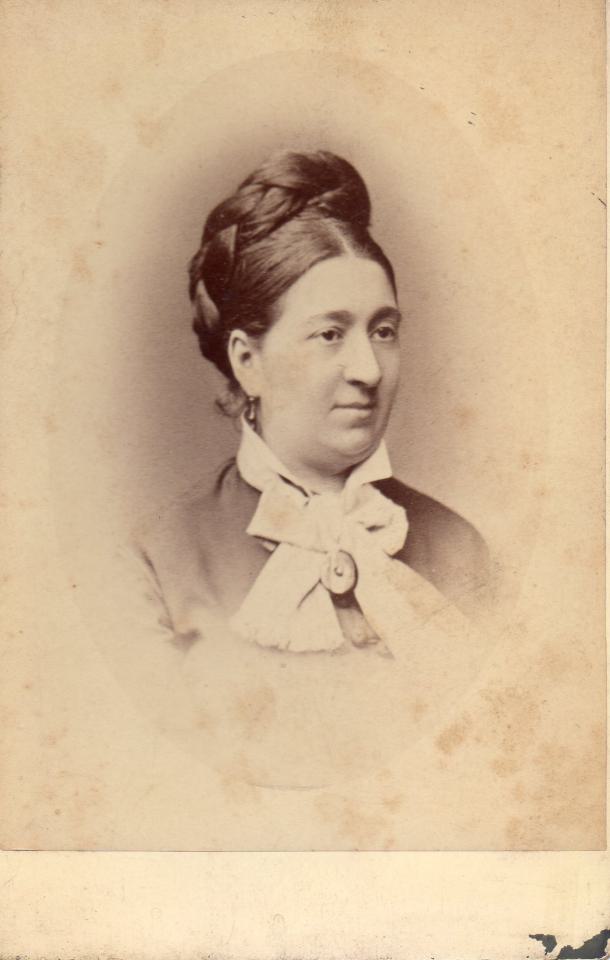
Henriette Heinemann née Lindenberg was born in 1836 into the Lindenberg family living in Vilsen near Hoya. She was the first of six children of Gerson David Lindenberg and his wife Rosa Salomon, who came from Winsen.
During an invitation at the Wahlstab house in Lüneburg (today"s Heine House) in the 1850s, Henriette met Marcus Heinemann, who was still a merchant"s assistant at the time. Their marriage in 1856 marked the beginning of a close relationship between the Lindenberg and Heinemann families: Henriette"s sister Sophie married Marcus" brother Salomon Heinemann shortly thereafter, and her parents Gerson David and Rosa later moved to Lüneburg to join their children. Henriette"s younger brother Ferdinand also came to live in Lüneburg in the 1880s. In the next generation, there was again a marriage: Emma Heinemann, daughter of Marcus and Henriette, married Adolf Lindenberg, Henriette"s brother, in 1879.
According to family lore, Marcus had to court the much younger Henriette for a long time before she decided to marry him. When she finally accepted, he wrote to her, "You have not entrusted yourself to an unworthy man: my whole life shall serve to make you happy."
The two had 17 children together over the next few years, two of whom died in infancy. Until 1862 they lived as part of the extended family in the ancestral home at Bardowicker Strasse 6, after which Marcus Heinemann bought an old patrician house at Große Bäckerstraße 23 for his growing family. Daughter Clara wrote retrospectively about her parents: "One can hardly imagine a more harmonious marriage."
All the older children later remembered their mother as always in a good mood, always on the move, extremely communicative. Daughter Clara wrote in 1934: "My mother was not awakened until shortly before seven, she quickly got up and provided the coffee herself. One after the other, all the children appeared, at times also a young girl who assisted my mother, and the young people who lived with us and worked in the store. A friendly word was exchanged with everyone. My mother did not leave the coffee table until the last person had finished his drink. During the time she was never idle, she usually knitted a few booties. Then the real work began."
And daughter Emilie noted in 1936: "Our mother was a pretty woman; in spite of the 17 children. A son-in-law said, she looked better than all her 17 children. Our mother was always active, she may have complained of headaches at times, but we children did not feel that the many children had caused her any discomfort. One child had to help the other, there was not much help. [...] Mama had dark eyes and beautiful dark lichens. [She] unfortunately died by infection of the midwife, science was not ready at the moment. She was already knitting in bed after Henry"s birth when she had to die from such a sad cause. Papa could not contain himself at first, but his fear of God kept him going."
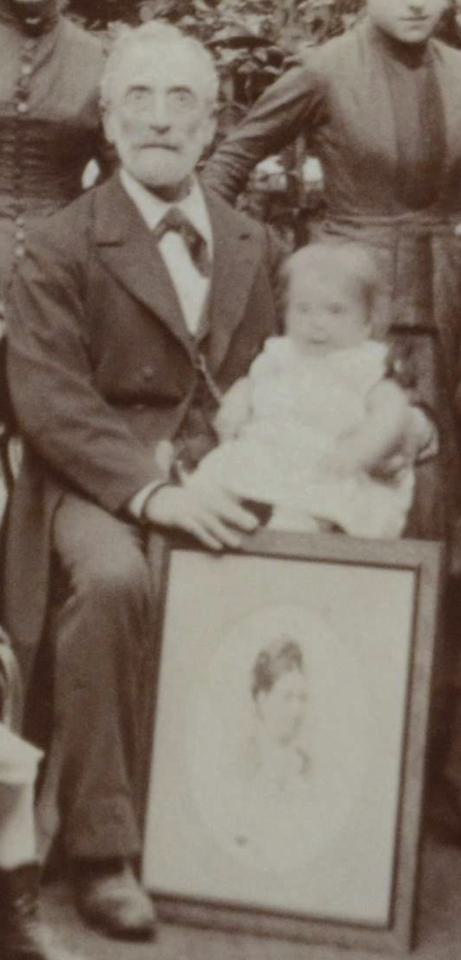
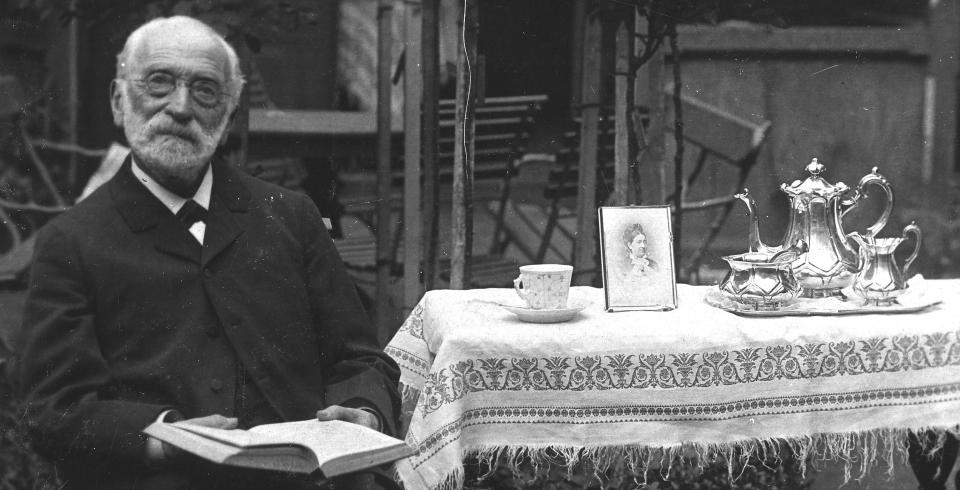
Until the end of his life in 1908, Marcus Heinemann always had a portrait of Henriette near him, and it can also be seen in several photographs.
Henriette was buried in Lüneburg"s Jewish cemetery. Her gravestone is one of the few that remained after the cemetery was destroyed and completely leveled during the Nazi era. Together with several other gravestones, it had been used as building material for the foundations of a makeshift home which was erected in 1944. When this makeshift home was demolished in 1967, Henriette"s stone came to light, along with a few others. It took a few more years before the gravestones were re-erected in the early 1970s, only as fragments and not in their original position.
Sources and information (in German):
Gravestone for Henriette Heinemann: epidat - Forschungsplattform jüdische Grabsteinepigraphik, Lüneburg, lbg-1
History of Lindenberg family, Vilsen
Letter from Marcus Heinemann to Henriette Lindenberg: Quoted by Manfred Göske from the original kept in the Jacobson family
Manfred Göske: Heinemanns, MS, Göske Collection, Museum Lüneburg
Letter from Klara Jacobson née Heinemann to her daughter Dr. Anna Jacobson, November 1934, with memoirs. Transcription by Manfred Göske; Stadtarchiv Lüneburg, NMa 117
Memoirs of Emilie Heinemann; Stadtarchiv Lüneburg, NBi33